
This Week in American History: 1912 – Titanic Survivors Reach New York
• Apr. 18. Today in 1912, the ocean liner RMS Carpathia enters New York City. A heavy rain is falling as Carpathia enters the harbor with over 700 passengers from the ill-fated Titanic. Carpathia was nearly 70 miles from Titanic when the sinking ship’s distress call was received. Despite danger from icebergs, under the command of Captain Arthur Rostron, Carpathia made her best speed to the disaster to find Titanic had already sunk and rescued surviving passengers from the frigid waters.
By ANDY KOBER
Here is what happened this week in American History.
• Apr. 16. On this day in 2018, the Pulitzer Prize for Public Service is awarded to both The New York Times and New Yorker for breaking the Harvey Weinstein sexual abuse scandal. Weinstein was a principal in the Miramax film production company and later of The Weinstein Company. Weinstein had a reputation for taking advantage of actresses. Since then over 80 women have accused Weinstein of sexual harassment, assault, or rape.
• Apr. 17. In 1524, long before America is a country, Italian explorer Giovanni da Verrazzano reaches what will become New York harbor. Verrazzano becomes the first European to explore the Atlantic cost between Florida and New Brunswick, Canada.
• Apr. 18. Today in 1912, the ocean liner RMS Carpathia enters New York City. A heavy rain is falling as Carpathia enters the harbor with over 700 passengers from the ill-fated Titanic. Carpathia was nearly 70 miles from Titanic when the sinking ship’s distress call was received. Despite danger from icebergs, under the command of Captain Arthur Rostron, Carpathia made her best speed to the disaster to find Titanic had already sunk and rescued surviving passengers from the frigid waters. She then sailed for New York at an average speed of 14 knots, just slightly less than her best speed when completed in 1903. Carpathia’s end would not be pleasant. On July 15, 1918, she was part of a convoy from Liverpool heading to Boston and struck by a torpedo from U-55. After passengers and crew had abandoned Carpathia, she was struck by two more torpedoes and sunk. The wreck was discovered by Clive Cussler and NUMA in 2000.
• Apr. 19. On this day in 1816, not all northerners were against the secessionist South as antiwar Democrats and Confederate sympathizers in Baltimore battle members of the Massachusetts and Pennsylvania militias. Five Union soldiers and 12 Confederate sympathizers die in the melee that is remembered as the Baltimore Riot of 1861.
• Apr. 20. In 2008, race car driver Danica Patrick wins the Indy Japan 300. This makes her the first woman to win an Indy car race.
• Apr. 21. Today in 1962, the Seattle World’s Fair opens. It was the first World’s Fair to be held in the US since the end of World War II.
• Apr. 22. On this day in 1951, China has three field armies totaling about 700,000 men poised ready to attack South Korean, UN and US forces in the Korean War. The Chinese call their offensive the Fifth Phase Offensive with attacks that become the Battle of Imjin River and Battle of Kapyong. At Imjin River, the Chinese attack is against British and Belgium forces. Against vastly superior numbers, the UN forces supported by tanks and artillery hold for three days before being forced to fall back. At Kapyong, the Chinese attack fell against British, Australian, Canadian, American, and South Korean troops, also supported by tanks and artillery. The American forces included A Company 72nd Heavy Tank Battalion, 5th Cavalry Regiment, 213th Field Artillery Battalion, 2nd Chemical Mortar Battalion, and 74th Engineer Combat Battalion. While the many of the South Korean soldiers fled the battle, the others fought inflicting large numbers of casualties among the Chinese.
Before you go...
Thanks for reading The-Star-Mercury-Vindicator. We hope this article added to your day.
We are a nonprofit, local newsroom that connects you to the whole story of Meriwether County. We live, work and play here. Our reporting illuminates and celebrates the people and events that make West Georgia unique.
If you appreciate what we do, please join the readers like you who help make our solution-focused journalism possible. Thank you
Author

Related Articles

Andy’s Astronomy: Planets of Space: 1999
In 1975, the British science fiction series Space: 1999 aired and introduced audiences to a number of planets including Psychon, Betha, Delta, and Terra Nova.
Lasting just two seasons, Space: 1999 was based on a premise the Moon had been used for stockpiling nuclear waste. Also located on the Moon, was Moonbase Alpha research center housed in the crater Plato. Some type of magnetic radiation causes the nuclear waste to go critical which blasts the Moon out of Earth orbit and into deep space, through worm holes and other astrological phenomena.
Along their travels, the crew of Moonbase Alpha discover other civilizations which was good as without the Moon, the Earth is rendered uninhabitable with life as we know it going extinct.
Of the planets highlighted in Space: 1999, none are real or based on real planets.
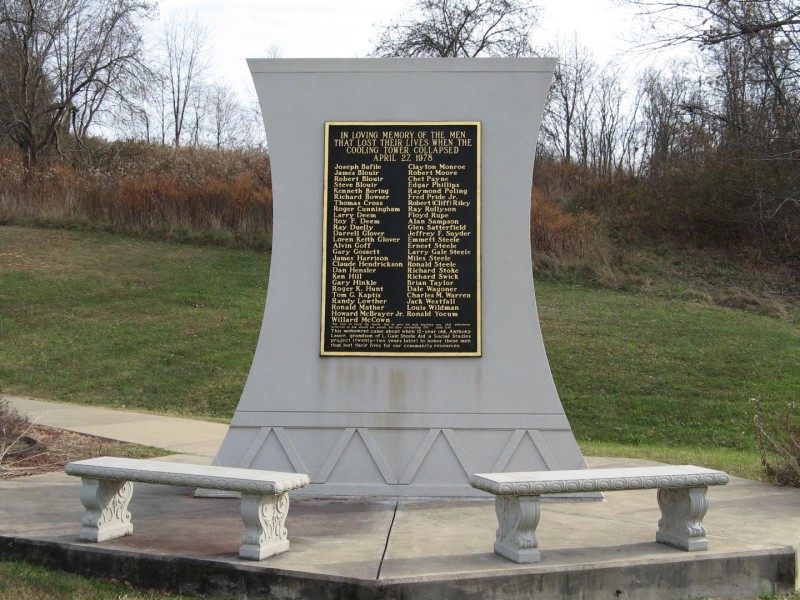
This Week in American History: 1978 – 51 Workers Die in Nuclear Construction Accident
• Apr. 27. In 1978, construction is underway on a second cooling tower at the Pleasants Power Station in Willow Island, West Virginia. The tower had reached a height of 166 feet when about 10 am, concrete poured the previous day began to collapse. Concrete, wooden forms, and metal scaffolding began collapsing to the ground inside the tower. Falling to their deaths were 51 construction workers.

DID YOU KNOW …? Did the set of a 1982 horror movie feature a poster for something that would not happen for another six years?
Trying to come up with an introduction to the column this week is akin to trying to pan for gold in that lake in Yellowstone Park that dissolves you … I’m having no success at all.
So, for the rare moment, I’ll just say the heck with it, wish you a wonderful week, and send you on to the trivia. Enjoy!